TL;DR: Paper bags come from softwood trees like pine and spruce. The wood is chipped, cooked into pulp, pressed into kraft paper sheets, and then cut and folded into bags. The first paper bag machine was invented in 1852 by Francis Wolle, and the flat-bottomed design we know today was created by Margaret E. Knight in 1871. Most brown paper bags are made from kraft paper, which skips the bleaching process for a stronger, more natural product. Paper Mart carries wholesale paper bags in every style, from standard brown bags to custom branded shopping bags.
You grab one at the grocery store without thinking. You toss your lunch in one before heading to work. You carry one down the street after a shopping trip. But where did the paper bag actually come from? The answer goes back more than 170 years, involves a schoolteacher, a pioneering female inventor, and a revolution in how the world packages goods. Whether you’re curious about the history, the manufacturing process, or the different types of paper bags available today, this guide covers it all.
Where Does a Paper Bag Come From?
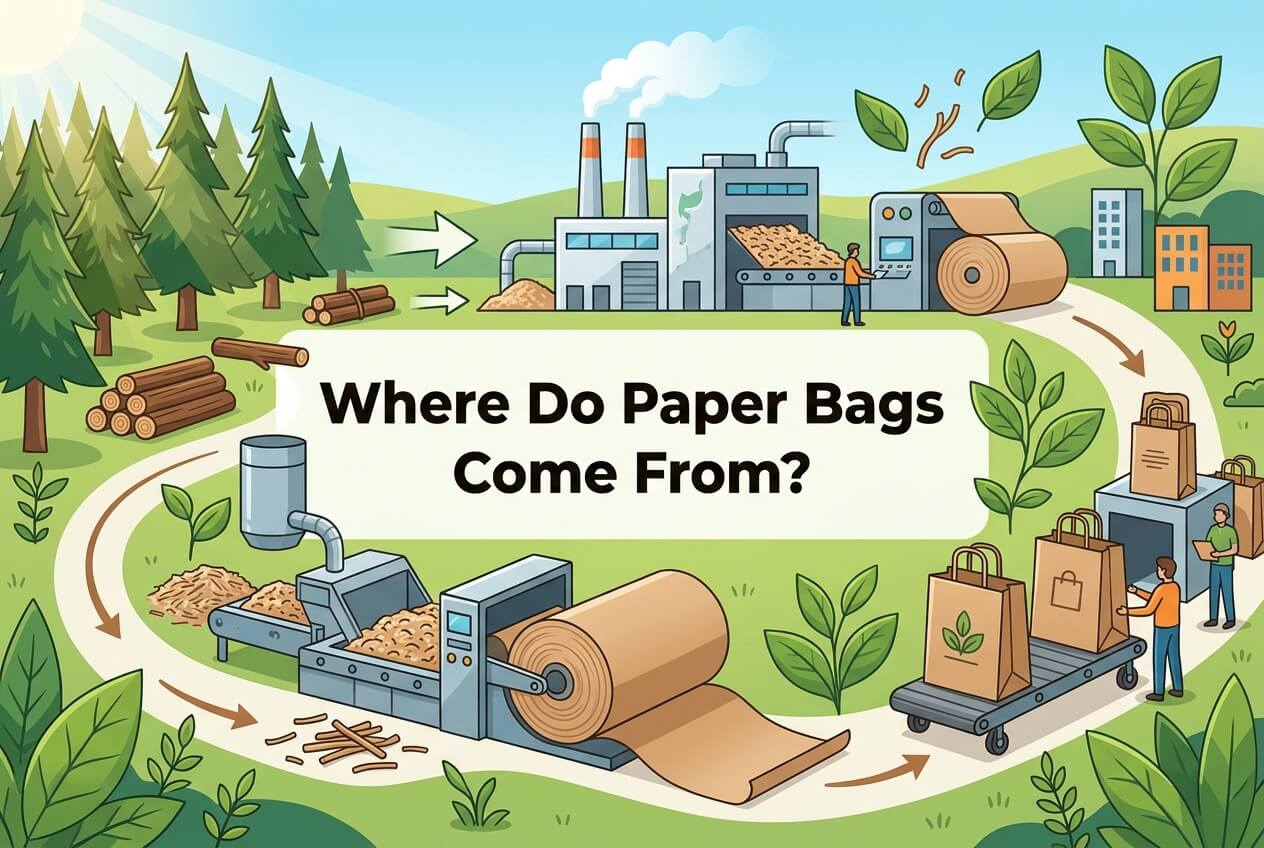
Every paper bag starts as a tree. Softwood species like pine and spruce are the most common raw materials. The trees are harvested, stripped of bark, and chipped into small pieces. Those chips are then cooked in a chemical solution that breaks them down into paper pulp. The pulp is cleaned, pressed into thin sheets, dried on massive rollers, and wound into paper rolls. From there, those rolls are cut, folded, glued, and shaped into the paper bags we recognize. Most standard brown paper bags are made from kraft paper, a material valued for its strength and flexibility. Virgin kraft paper uses fresh wood fibers, while recycled paper pulp can also be processed into new bags. The production of paper bags is a balance between sourcing raw materials responsibly and meeting massive global demand.
How Did the Paper Bag Get Invented?
The paper bag came into existence in 1852 when Francis Wolle, a Pennsylvania schoolteacher, invented the first machine to mass-produce them. Wolle and his brother patented the device and founded the Union Paper Bag Company. Those early bags were simple, flat, envelope-style paper bags. They could hold lightweight items, but they weren’t practical for heavier goods.
The real breakthrough happened in 1871. Margaret E. Knight, working at the Columbia Paper Bag Company in Springfield, Massachusetts, designed a machine that could fold paper automatically into a flat-bottom paper bag. Her design changed everything. A flat-bottomed paper bag could stand upright, hold more weight, and was far more useful for shoppers and retailers. Knight fought a patent battle against a copycat who tried to steal her design, won her case, and earned her place in history.
What Types of Paper Bags Exist Today?
There are many different types of paper bags, and each serves a specific purpose. The standard brown paper bag is the one most people picture first. It’s a grocery bag staple, made from kraft paper, and used for everything from packed lunches to retail packaging.
Beyond that, the variety of styles of paper bags is impressive. SOS bags (Self-Opening Sacks) have pleated sides and a square bottom. Paper shopping bags come with twisted or flat handles for easier carrying. Merchandise bags are flat paper bags used in retail. Bakery bags often have a window for displaying baked goods. Euro totes have rope handles and a more premium feel. White paper bags and colored options offer branding flexibility for retailers.
Gift bags deserve their own mention. They come in countless colors, patterns, and finishes, from glossy metallics to soft mattes. Paper Mart carries a huge selection of gift bags for every occasion.
Each type of paper bag fills a different role. The key is matching the right bag to the right use.
Can You Buy Paper Bags in Bulk?
Absolutely. Buying paper bags in bulk is the most cost-effective option for businesses. Whether you run a bakery, a boutique, a restaurant, or a grocery store, purchasing bags per case keeps costs down. Paper Mart offers bulk pricing across every category of paper bag, from standard brown paper bags to custom paper bags with your logo.
Buying in bulk also means you won’t run out when it matters most. Nothing hurts a customer experience faster than not having a bag ready at checkout.
Why Choose Paper Bags Over Plastic?
The paper or plastic debate has been going on for decades. Here’s why paper bags have gained serious ground. Paper bags are biodegradable. They break down naturally, unlike plastic bags that can persist in the environment for hundreds of years. Paper bags are also easier to recycle and can be made using recycled paper.
The impact of paper bags on the environment is not zero, of course. Paper production requires water and energy. But when you weigh the full lifecycle, paper bags over plastic come out ahead in terms of recyclability and biodegradation. Many cities and states have enacted plastic bag bans, making paper the default choice. For businesses, switching to paper bags also sends a message to customers about environmental responsibility.
Where Can I Find Affordable Paper Bags for My Business?
Paper Mart is a wholesale packaging supplier with over 100 years in the business. They carry paper bags in every style, size, and color, all at wholesale prices. Whether you need standard brown paper bags for a grocery operation, branded shopping bags for your retail store, or eco-friendly kraft bags for an event, Paper Mart has it covered. They also offer custom paper bags with hot stamping, so you can personalize bags with your logo for marketing and branding.
Where Do Paper Bags Come From?
Paper bags come from trees. That’s the short answer. The longer answer involves a fascinating process that turns raw wood into the lightweight, versatile packaging we use every day. It starts in managed forests, where softwood trees like pine and spruce are harvested for their long, strong fibers. Those trees are debarred, chipped, and cooked in a chemical bath that breaks the wood down into paper pulp. That pulp is then cleaned, pressed, and dried into large rolls of kraft paper bag material, which is the foundation for nearly every paper bag on the market.
From there, the sheet of paper is fed through converting machines that cut, fold, and glue it into finished bags. Making paper bags at scale requires precision. The machines handle everything from creasing the flat bottom to attaching handles. Different types of bags require different setups, but the core process is the same: wood becomes pulp and then into paper, and paper becomes bags. Paper bags with handles, for example, go through an additional step where twisted cord or flat strips are inserted and secured during manufacturing a paper bag.
The material matters. Most standard brown bags are made from kraft paper, which skips the bleaching process to preserve fiber strength. This is why kraft paper packaging is naturally brown. It’s also why brown bags hold up so well under weight. White bags go through extra refining, which produces a cleaner look but slightly less tensile strength. Either way, paper bags can be made from virgin fibers, recycled content, or a blend of both. Using recycled paper pulp reduces the demand on forests and cuts energy use during production.
What makes paper packaging a smart choice is that the entire cycle is renewable. Trees grow back. Paper is biodegradable. And modern paper production has become significantly more efficient over the past few decades. Whether you’re buying a small merchandise bag or a case of heavy-duty shopping bags, every one of them traces back to the same source: a sheet of paper, made of paper fibers, manufactured into a bag designed to carry what you need.
How Are Brown Paper Bags Made?
Brown paper bags are made from kraft paper, which gets its characteristic color from the wood fibers used in the process. The kraft process involves cooking wood chips in a solution of sodium hydroxide and sodium sulfide. This breaks the wood down into individual fibers while preserving their natural strength.
The resulting paper is strong, tear-resistant, and naturally brown. Standard brown paper bags skip the bleaching step that white paper bags go through, which actually makes the manufacturing of paper bags more efficient and less chemically intensive. Brown paper bags are also commonly made using recycled paper, further reducing the environmental footprint of paper bag manufacturing.
What’s the Best Paper Bag for Retail and Shopping?
For retail, paper shopping bags with handles are the most popular choice. They look professional, carry well, and offer a great surface for branding. Carrying a branded shopping bag down the street is free advertising. That’s why so many retailers invest in bags with their logos.
Paper Mart offers paper shopping bags in kraft, white, and colored options. Twisted-handle bags are a classic choice. Euro totes with rope handles offer an upscale feel for boutiques and specialty shops. For businesses looking to make an impression, these bags are a simple but effective branding tool. Paper bags in retail have become more than just packaging. They’re part of the customer experience.
What Is the Difference Between Kraft Paper and Regular Paper?
Kraft paper is made specifically for strength. The kraft process preserves longer wood fibers, which makes the resulting paper and board more durable and tear-resistant. Regular paper, like what you’d use in a printer, goes through additional bleaching and refining that makes it smoother but weaker.
For paper bags, kraft paper is the standard. It’s the reason a grocery bag can hold 20 pounds of food without ripping. Virgin kraft paper uses fresh fibers and offers the highest strength. Recycled kraft paper uses post-consumer fibers and is the more sustainable option. Both types are widely used in the paper bag industry.
How Did Paper Bags Become So Popular in Stores?
In 1912, a grocer named Walter Deubener figured out how to add handles to paper shopping bags by threading cord through the standard paper sack. His “Deubener Shopping Bags” could hold up to 75 pounds and became wildly popular, selling over a million bags per year by 1915. Paper shopping bags eventually became the standard for department stores and retailers.
By the mid-20th century, retailers were giving paper bags away for free as part of the shopping experience. Stores printed bags with their logos, turning a simple grocery bag into a branding tool. Carrying a shopping bag down the street became a form of advertising. The bags were the inspiration for what we now think of as branded retail packaging.
Plastic bags entered the picture in the 1970s and gradually replaced paper in many stores due to lower cost. But with the widespread use of paper bags making a comeback thanks to plastic bag bans and growing environmental awareness, paper bags have become the preferred choice again for many businesses and consumers.
How Are Paper Bags Disposed of Properly?
Paper bags are disposed of easily. They’re accepted in most curbside recycling programs and can also be composted. Unlike plastic bags, which clog recycling machinery and litter waterways, paper bags break down naturally. Even if a paper bag ends up in a landfill, it will decompose far faster than a plastic alternative.
For the most eco-friendly cycle, reuse your paper bags a few times before recycling them. Paper bags can be used as storage, book covers, gift wrap, or even craft material. When they’ve reached the end of their life, toss them in the recycling bin.
Does the US Make Paper Products?
Yes. The United States is one of the largest producers of paper products in the world. The country has vast softwood forests, particularly in the Southeast and Pacific Northwest, that supply raw materials for paper production. American paper mills produce everything from printing paper to packaging materials to kraft paper for bags. Many paper bag manufacturers operate domestically, and a significant portion of the brown paper bags used in American stores are made right here in the US.
Where Is the US Poly Pack Located?
US Poly Pack is a packaging manufacturer based in Scottsdale, Arizona. They specialize in poly mailers, shipping bags, and various plastic packaging products. While they focus primarily on poly-based packaging rather than paper, they are one of many US-based companies in the broader packaging industry.
What Garbage Bags Are Made in the USA?
Several garbage bag brands manufacture their products in the United States. Glad, Hefty, and various store-brand options all have domestic manufacturing operations. These bags are typically made from polyethylene, not paper. For paper-based waste solutions, compostable paper yard waste bags are available from multiple domestic producers. Paper Mart focuses on retail, food service, and gift packaging rather than garbage bags, but the broader American packaging industry covers the full range of bag types.
What’s the Best Place to Buy Paper Bags in Bulk Online?
Paper Mart is one of the leading wholesale paper bag suppliers in the country. With over a century of experience, they carry one of the largest selections of paper bags available anywhere. From standard brown paper bags and SOS bags to custom printed shopping bags, everything ships same day and is backed by award-winning customer service. Whether you need 25 bags or 25,000, Paper Mart offers volume discounts that make bulk buying smart and simple.
Key Takeaways
- The paper bag came from a simple invention in 1852 and has evolved dramatically over nearly two centuries
- Most paper bags are made from kraft paper, produced by processing wood chips into paper pulp
- Margaret E. Knight invented the flat-bottomed paper bag machine in 1871, changing the paper bag industry forever
- Different types of paper bags serve different purposes, from grocery bags to gift bags to branded shopping bags
- Brown paper bags get their color from the natural kraft process, which skips bleaching for a stronger, more efficient product
- Paper bags are biodegradable, recyclable, and increasingly preferred over plastic bags by consumers and lawmakers
- Paper Mart offers wholesale paper bags in every style, size, and color, with same-day shipping and bulk pricing
- The US is a major producer of paper products, and many paper bags sold domestically are manufactured in America
- Custom paper bags with logos are an effective, low-cost tool for bags for marketing and branding
- Reuse and recycle your paper bags to minimize environmental impact