
TLDR: Bubble wrap is a protective packaging material consisting of plastic sheets with air-filled bubbles that was accidentally invented in 1957 by two engineers trying to create wallpaper. What is bubble wrap made of: It’s manufactured from polyethylene resin beads that are melted and formed into two layers of clear plastic film, with one layer sucked into holes to create bubbles before being sealed with the second layer. Different types of bubble wrap include standard, anti-static (pink), recycled (green), adhesive, cohesive, flame retardant, reflective insulation, bubble bags, and bubble mailers, available in various sizes from lightweight to heavy duty. Bubble wrap is lightweight, moisture-resistant, provides cushioning and insulation, and has become so beloved that January 27th is Bubble Wrap Appreciation Day.
Interesting Facts about Bubble Wrap
Bubble Wrap is one of the most practical packaging methods out there, not to mention it’s a whole lot of fun!
Bubbleful Facts on Bubble Wrap!
Infographic Transcript:
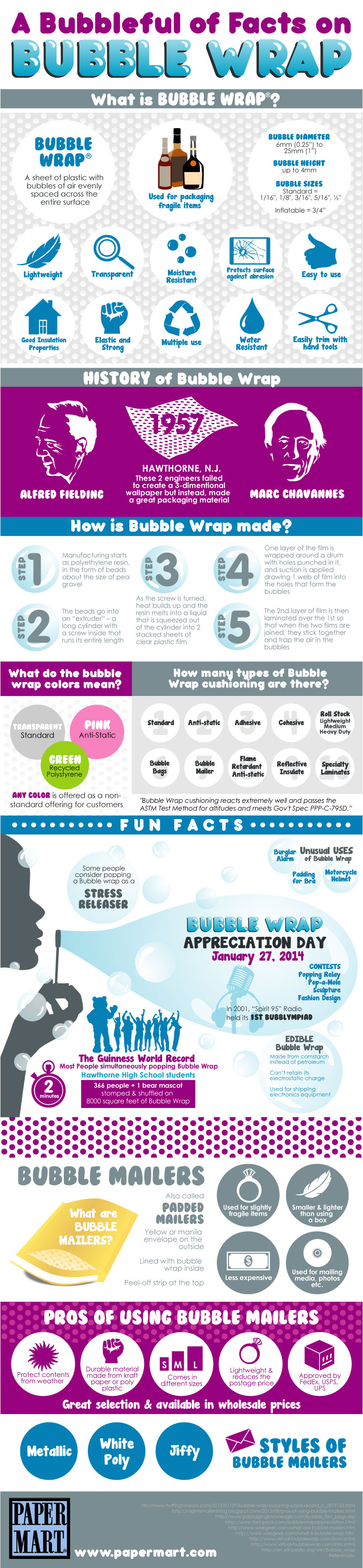
What is Bubble Wrap?
- Bubble Wrap is a sheet of plastic with bubbles of air evenly spaced across the entire surface used for packaging fragile items.
- Bubble diameter: 6mm (0.25”) to 25mm (1”).
- Bubble height: up to 4 mm
- Bubble sizes: Standard = 1/16”, 1/8”, 3/16”, 5/16”, 1/2”
- Inflatable = 3/4”
Common Traits of Bubble Wrap:
- Lightweight
- Transparent
- Moisture resistant
- Protects surfaces against abrasion
- Easy to use
- Good insulation properties
- Elastic and strong
- Multiple uses
- Water resistant
- Easily trimmed with hand tools
History of Bubble Wrap
In 1957, in Hawthorne, New Jersey, Alfred Fielding, and Marc Chavannes, two engineers, failed to create a three-dimensional wallpaper but instead, made a great packing material!
How is it made?
Step 1: Manufacturing starts as polyethylene resin, in the form of beads about the size of pea gravel.
Step 2: The beads go into an ‘extruder’ – a long cylinder with a screw inside that runs its entire length.
Step 3: As the screw is turned, heat builds up and the resin melts into a liquid that is squeezed out of the cylinder into two stacked sheets of clear plastic film.
Step 4: One layer of the film is wrapped around a drum with holes punched in it, and suction is applied, drawing one web of film into the holes that form the bubbles.
Step 5: The second layer of film is then laminated over the first so that when the two films are joined, they stick together and trap the air in the bubbles.
What do the different colors mean?
- Transparent: Standard
- Pink: Anti-static
- Green: Recycled polystyrene
- (Any color is offered as a non-standard offering for customers).
How many types of Bubble Wrap cushioning is there?
- Standard
- Anti-static
- Adhesive
- Cohesive
- Roll stock: lightweight / medium / heavy duty
- Bubble bags
- Bubble mailer
- Flame retardant anti-static
- Reflective insulate
- Special laminates
“Bubble Wrap cushioning reacts extremely well and passes the ASTM Test Method for altitudes and meets Gov’t Spec PPP-C-795D.”
Fun Facts
Some people consider popping bubble wrap a stress releaser.
Unusual uses for bubble wrap:
1. Burglar alarm
2. Padding for bra
3. Motorcycle helmet
Bubble Wrap Appreciation Day is January 27th. Contests include a popping relay, pop-a-mole, sculpture, fashion design, and in 2001, Spirit 95 Radio held its first Bubblympiad.
The Guinness World Record for the Most People Simultaneously Popping Bubble Wrap belongs to Hawthorne High School students who had 366 people and one bear mascot who stomped and shuffled on 8,000 square-feet of Bubble Wrap for two minutes.
What are Bubble Mailers?
Bubble mailers, or padded mailers, are envelopes that are yellow or manila on the outside that are lined with bubble wrap on the inside with a peel-off strip on the top.
- Used for slightly fragile items
- Smaller and lighter than using a box
- Less expensive
- Used for mailing media, photos, etc.
Pros of using Bubble Mailers:
- Protect contents from weather
- Durable material made from kraft paper or poly plastic
- Available in different sized
- Lightweight so they save on postage expenses
- Approved by FedEx, UPS and USPS
Styles of Bubble Mailers:
- Metallic
- White poly
- Jiffy
Key Takeaways:
- Bubble wrap is made from polyethylene resin beads that are heated and melted in an extruder, then formed into two layers of plastic film with air trapped between them to create protective bubbles.
- The manufacturing process involves wrapping one film layer around a perforated drum where suction pulls the film into holes to form bubbles, then laminating a second layer on top to seal in the air.
- There are 10+ types of bubble wrap cushioning including standard, anti-static (pink), adhesive, cohesive, flame retardant anti-static, reflective insulate, and special laminates.
- Roll stock comes in three weight categories: lightweight, medium, and heavy duty, depending on your protection needs.
- Color-coding indicates special properties: transparent is standard, pink is anti-static for electronics, green is made from recycled polystyrene, and custom colors are available.
- Bubble sizes range from 1/16″ to 3/4″, with standard sizes being 1/16″, 1/8″, 3/16″, 5/16″, and 1/2″ for regular bubble wrap, plus 3/4″ for inflatable cushioning.
- Bubble mailers combine kraft paper or poly plastic exterior with bubble wrap lining, offering a lightweight, cost-effective shipping solution that saves on postage compared to boxes.
Hello,
Thank you for the article. May I ask a question?
What does Bubble sizes: Standard = 1/16”, 1/8”, 3/16”, 5/16”, 1/2” means?
Bubble size=bubble diameter?
bubble diameter=1/16”= 1.5875mm?
bubble diameter=1/8”= 3.175mm?
bubble diameter=3/16”= 4.7625mm?
bubble diameter=5/16”= 7.9375mm?
bubble diameter=1/2”= 12.7mm?
Am I right? or they means bubble hight?
Thanks for your time.
Maggie
Hi Maggie! Glad you liked it. Yes! Usually when bubble sizes are referenced like this, it’s referring to the size of each individual bubble. If you have more bubble wrapping questions, feel free to reach out to us at 800.745.8800, ext. 2. Our Customer Care team is available Monday-Friday from 6:00AM – 5:00PM PST.